
Harris Westminster students negotiated tariffs, tech controls, and crisis diplomacy – here’s what they discovered
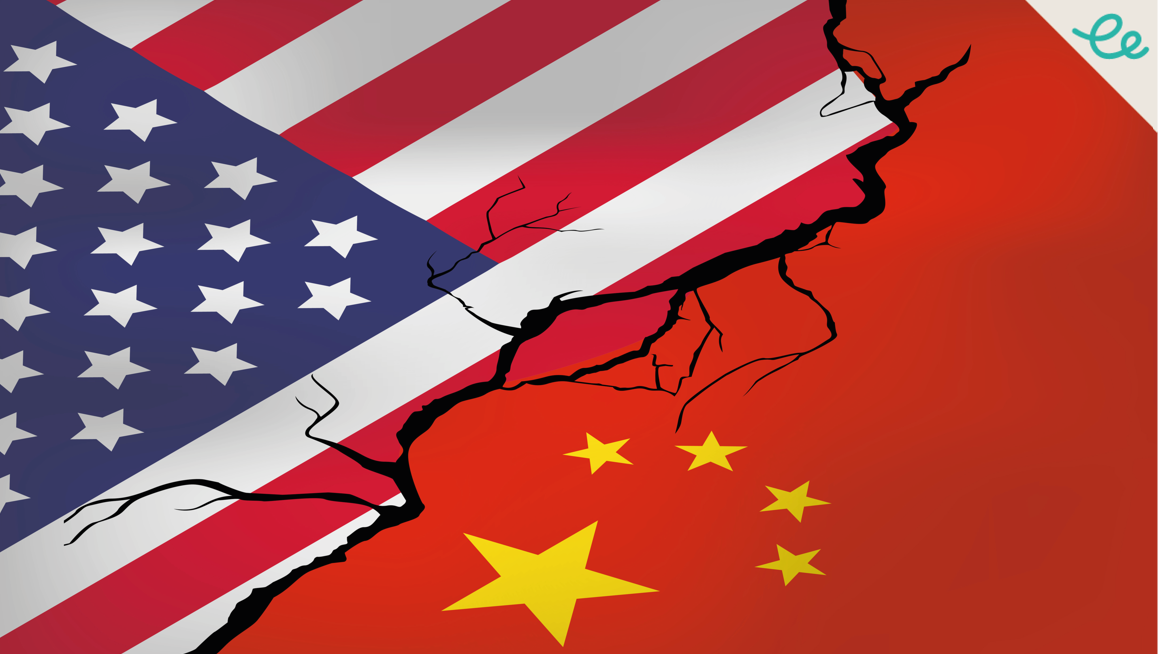
Last December, sixth-form students at Harris Westminster Sixth Form school in London took part in a hands-on exploration of one of the defining questions of our era: how the United States and China navigate a relationship built on both deep interdependence and sharpening rivalry.
The programme began with a lecture from Diana Choyleva, setting out the economic and geopolitical background to the US–China relationship – the trade flows, technological rivalries, and strategic anxieties that shape decision-making in Washington and Beijing today. Building on that context, Diana and her colleague Jiaming Gu, an economist at Enodo Economics, then ran a 60-minute “US–China Trade War Simulation,” in which students took on the roles of the two powers themselves.
Split into two delegations, Team US and Team China, students had to weigh their country’s goals, strengths, and constraints, choosing from a set of policy cards spanning tariffs, technology controls, investment restrictions, and cooperation. They negotiated directly with the opposing delegation, then had to respond in real time to a crisis scenario that tested how quickly cooperation can give way to confrontation – and vice versa.
The simulation was designed to help students understand the economic logic behind cooperation and conflict, the role of trade, technology, and domestic politics in shaping national strategy, and to think critically about real-world policy dilemmas through hands-on decision-making.
To build on the energy of the day, students were invited to enter an essay competition on the themes explored during the simulation. Below, we share the winning essay, written by Vivaan Desai – a genuinely impressive piece of independent thinking on the future of US–China relations.
How Can China and the United States Find a Way to Coexist Peacefully in the 21st Century?
Vivaan Desai
U.S.-China relations are the central geopolitical relationship of the 21st century due to their military and economic strength; in the current political landscape, they are often considered the two most powerful and influential countries in the world. The relationship between these two global powers shapes global security, the world economy, technological development, and international institutions. The relationship between China and the US has deteriorated significantly in recent years, due to ongoing strategic rivalry, ideological differences, and economic and technological competition; both sides increasingly see the other as a systemic challenge.
Whilst the idea of complete cooperation or harmony is unlikely, it is also unrealistic to believe that conflict is inevitable. The real challenge is managing their rivalry, not eliminating it. Peaceful coexistence does not mean trust, shared values, or the absence of competition; it simply means avoiding military conflict, limiting escalation, and maintaining stability between the two nations. The argument throughout this essay will be that peaceful coexistence is possible, but only through managed competition, clear rules, and selective cooperation.
This essay will cover the causes of the divide, the risks posed to the global community if the rivalry is unmanaged, what coexistence would realistically look like, and the role of younger generations in cooperation.
China’s rapid economic and military growth in the 21st century has altered the global balance of power; the US increasingly sees China as a challenger to its long-standing dominance. Similar to the Cold War, when the US aimed to contain the spread of Communism, US alliances and its ever-growing military presence in Asia are, from China’s perspective, viewed as attempts at containment. From the US perspective, China’s rise stirs fear of relative decline and loss of influence. This fits power transition theory, developed by A.F.K Organski in 1958, which essentially suggests that an even distribution of power among nations can lead to instability and even conflict; peace is most likely to be maintained when there is a clear hierarchy with one country at the top. Rising and established powers are structurally prone to rivalry.
The rivalry has also been exacerbated by key ideological and political differences between the US and China: the US focuses on liberal democracy, whilst China has a one-party authoritarian political system. The US has concerns about human rights, surveillance, and political influence, whilst China has concerns about regime security and Western interference and influence in Asia. Contrasting ideologies affect trust, perceptions of legitimacy, and willingness to cooperate.
Moreover, there is significant economic competition between the two countries, including trade disputes, industrial policy, and supply chain security. There is also technological competition between them, including semiconductors, AI, data and cybersecurity. Additionally, military modernisation in both countries over the past few years has aggravated rivalry. These differences make compromise politically more complicated.
Unmanaged rivalry between the US and China poses serious risks not only to bilateral relations but also to global stability. Since both sides are deeply embedded in international economic, political, and security systems, escalation would have worldwide consequences. Military conflict and escalation pose a significant risk, particularly in the context of Taiwan. Taiwan involves core national interests for both sides. For China, Taiwan is viewed as an inseparable part of Chinese territory. Reunification is tied to China’s sovereignty and national identity, making compromise extremely difficult.
Meanwhile, the US seeks to preserve the status quo in East Asia; it follows a policy of strategic ambiguity and has not explicitly committed to military support for Taiwan in case of a Chinese invasion. This is dangerous, as strategic ambiguity raises the risk of miscalculation: China may underestimate the US’s willingness to intervene, and Taiwan may overestimate the level of US support. The Taiwan Strait is also a major military factor; it is one of the world’s most critical geopolitical and economic chokepoints, as it connects the South China Sea to the East China Sea and serves as a high-traffic shipping lane for global commerce. This has led to frequent military exercises and patrols by China, which aim to occupy the strait, causing significant military tension with the US.
Taiwan can also be seen as a test of US credibility and Chinese regional control; either side backing down could be interpreted as a sign of weakness. Economic fragmentation is also a key issue; trade tensions, including tariffs, export controls, and sanctions, are growing. This poses the risk of reduced global trade efficiency, higher consumer costs, and slower global economic growth. This means that smaller states are pressured to choose sides between the two global superpowers; developing economies are particularly vulnerable to disruption. There is also a significant technological competition, with the emergence of separate technological ecosystems.
This risks duplicating innovation and reducing global collaboration. Technology has become increasingly linked with national security, further heightening tensions. Furthermore, the US-China rivalry weakens international institutions, reducing the ability to cooperate on climate change and pandemics and worsening financial stability. Without clear rules, communication, and restraint, competition could escalate into conflict. This reinforces the need to explore what peaceful coexistence could realistically look like.
Peaceful coexistence between the United States and China can only be achieved if both states adopt a deliberate strategy for managing long-term rivalry rather than attempting to eliminate it. In practice, this requires accepting competition as a permanent feature of the relationship and imposing limits on how it is conducted. Efforts to fully contain China or to displace US influence entirely are likely to undermine coexistence by reinforcing zero-sum thinking and incentivising escalation. Instead, coexistence depends on restraint, predictability, and mutual recognition of strategic limits, where neither side seeks outright dominance over the other.
A central requirement for peaceful coexistence is more explicit signalling on core interests, particularly regarding Taiwan. While deterrence remains essential, coexistence requires reducing uncertainty by clarifying which actions would provoke escalation and by maintaining communication even during periods of heightened tension. Mechanisms such as military-to-military dialogue, crisis hotlines, and confidence-building measures do not imply trust or cooperation, but serve to stabilise rivalry by preventing miscalculation and unintended escalation. In this sense, deterrence supports coexistence not through provocation, but through credible restraint and clear communication.
Economic coexistence similarly requires managing competition rather than allowing it to escalate into a comprehensive economic confrontation. While it is legitimate for both states to protect narrowly defined security-sensitive sectors, peaceful coexistence depends on preventing rivalry from spilling over into all areas of trade and investment. Without such limits, economic competition risks becoming a tool of coercion rather than a form of rivalry within rules, affecting nations on a global scale. Peaceful coexistence in this scenario would require limiting restrictions to sensitive sectors, such as manufacturing or financial services, and allowing healthy competition to continue elsewhere. Shared rules do not require shared political systems.
Rules matter because they reduce uncertainty, create expectations and provide mechanisms short of force. Maritime law, trade rules, and emerging AI norms help prevent escalation through misinterpretation, retaliation from either nation, and uncontrolled technological competition. Institutions may be imperfect, but without them, disputes are settled by power alone, which can be highly problematic; peaceful coexistence depends more on procedures than on principles. Coexistence alone is not enough; even rivals must cooperate when interests clearly overlap, which in turn drives cooperation on global challenges such as climate change, health, and technology governance.
Cooperation between China and the US should be understood as functional rather than political; it can only really occur where interests align. The US-China relationship is not binary; competition and cooperation can and do coexist in different policy areas. However, it is essential to note that particular global challenges are structurally unsolvable by any single state, regardless of power or influence, which is where cooperation is pivotal.
Cooperation, therefore, emerges from strategic necessity on both sides and from self-interest. Even strategic rivals cooperate when the costs of not cooperating are high, there are shared benefits, or unilateral action is ineffective. This applies directly to China and the US. Cooperation does not require alignment of values, political convergence, or long-term trust, but rather overlapping interests and clear incentives.
Climate change is a feasible area for both nations to cooperate, as they are among the world’s most significant greenhouse gas emitters. Climate change will affect both nations due to environmental damage and economic disruption. Cooperation can include developing green technology and committing to reducing emissions. This will also improve communication between the two countries. In this instance, failure to cooperate would undermine both states’ long-term interests.
Additionally, they may collaborate on global health issues. Sharing and coordinating early information, particularly during a pandemic, would reduce global costs and limit economic disruption. Cooperation would benefit domestic populations and international stability, as we saw during the covid 19 pandemic: limited cooperation worsened the situation. Technology would also be a key area of collaboration in the current geopolitical climate. Unregulated technological competition increases the risk of accidental escalation, misuse of powers, and instability. Cooperation could focus particularly on crisis management; the idea is to reduce risk, not slow down innovation. Cooperation complements coexistence: it prevents conflict and mitigates shared risks. Together they form a pathway to peaceful relations.
To conclude, peaceful coexistence between China and the US is possible; it does not mean harmony or trust, but managed rivalry. Conflict is not inevitable, but its escalation is likely without deliberate constraints. The rivalry is structural and long-term, so the use of restraint, explicit signalling, deterrence through communication, and economic guardrails is vital. Rules, institutions, and procedures to stabilise competition are also necessary. Future generations will shape public attitudes about the two nations and influence leadership over time. Whilst young people do not override state interests, they do affect the context in which policy is made; they can exert long-term influence. Peaceful coexistence depends on the choices of the two nations, and stability will come from restraint and rules.