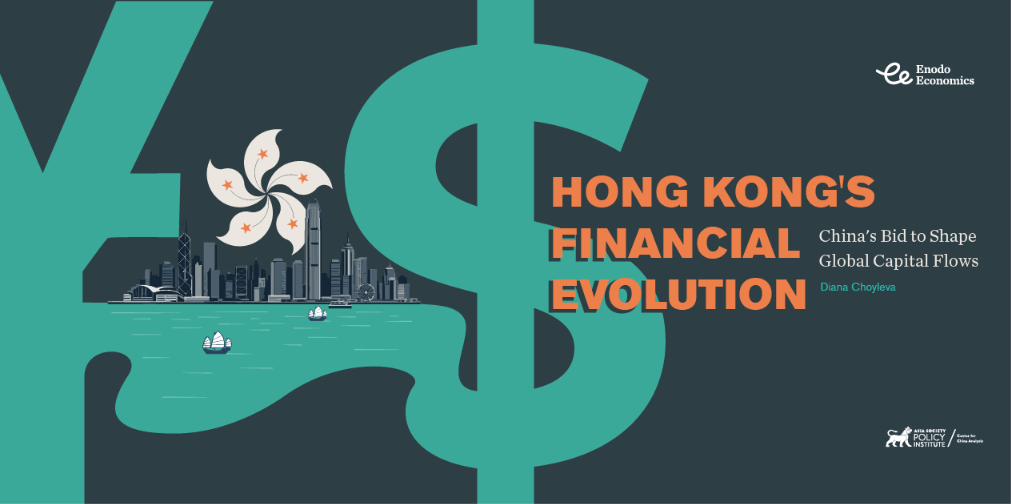
China’s Bid to Shape Global Capital Flows
Special Project
For a copy of the full report, please request below:
For five years, the dominant Western story about Hong Kong has been one of decline. Political autonomy has narrowed. International confidence has been damaged. Singapore has gained ground. The city is increasingly treated as a diminished version of the financial center it once was.
This report argues that this diagnosis misses the more consequential transformation underway. Beijing is not simply managing the erosion of a Western-style financial center. It is repurposing Hong Kong into the offshore financial platform of a stillcontrolled Chinese system, a place where China can obtain many of the benefits of financial openness without surrendering sovereign control over its capital account, the rules governing financial flows into and out of the mainland.
China’s model is neither conventional liberalization nor the older system of financial repression, in which household wealth was largely confined to onshore assets while the state accumulated and invested the country’s foreign exchange reserves. It is a third approach: financialization with Chinese characteristics.
Its defining mechanism is easy to misunderstand. Beijing is not opening a route through Hong Kong for Chinese wealth to disperse freely into global markets. Mainland capital moving south remains anchored in Hong Kong through closed-loop channels known collectively as Connect, whose eligible assets, settlement, and use of proceeds Beijing can supervise. What that anchored capital helps create is a deeper offshore financial ecosystem: liquidity, intermediaries, renminbi funding, internationally credible markets, and alternative settlement capacity. It is that financial reach, not unrestricted flow of Chinese savings, that Beijing seeks to project outward.
Hong Kong is indispensable because it supplies what the mainland cannot. It offers an internationally legible market, a common-law jurisdiction, convertible currency, global banks, foreign investors, and financial infrastructure that counterparties trust while remaining inside China’s sovereign perimeter. That combination is the strategic asset.
The evidence assembled in this report shows that Beijing has already built much of the machinery required to make the model work. What remains unresolved is whether that machinery can reach sufficient scale and attract enough independent foreign demand to erode American financial leverage without forcing China to liberalize on Western terms.
The report is the culmination of a year-and-a-half-long project, undertaken in collaboration with the Asia Society Policy Institute’s Center for China Analysis (CCA), which we thoroughly enjoyed.
Acknowledgements
This report would not have been possible without the steadfast support of the Asia Society Policy Institute’s Center for China Analysis, led by Jing Qian. I am grateful to Jing for providing me with the best home for this project I could have asked for. The entire team at the Center made invaluable contributions to bringing this work to fruition. Special thanks go to Jennifer Choo, Lizzi C. Lee, Jamie Liu, Wendy Ma and Betty Wang, whose collective expertise were instrumental in completing the project.
My colleagues at Enodo Economics have been invaluable in their unique ways. A huge thank you goes to my research team – Jiaming Gu, Alistair Burlinson, Daniel Kasabov – for their sparky intellectual contributions, thorough investigation and tireless work. Several bright student interns – Max Desmurs, Arvin Mohammadkhani, Siwei Chu – helped along the way and kept us all on our toes. Ani Manova’s creative design work gave the report its polished and professional appearance. Finally, special thanks to Tsveta Andonova, Seamus Keaveney, and Salma Abou Zaki for their constant encouragement and support.
This report benefited immensely from the guidance of a distinguished advisory panel. Nigel Inkster, John Greenwood and Diana Lowery provided invaluable strategic insights and expert feedback that significantly enhanced the depth and rigor of this analysis. Their combined expertise in financial markets, macroeconomics and geopolitics helped shape this report’s comprehensive examination of the evolving global monetary system.
We owe a large debt to all experts who took time out of their busy lives to help us deepen our knowledge, challenge our assumptions and give us new ideas: Nicolas Aguzin, Bonnie Chan, Laura M. Cha, Yi Gang, Charles Li, Richard Montague, Mu Changchun, Francesco Nagari, Qi Bin, Sheldon Ray, Andrew Sheng, Carlson Tong, Rich Turrin, Brian Wong, William Wu, Zhu Min, and all of those who spoke to us anonymously.
None of this would have been possible without the Smith Richardson Foundation whose grant provided the main financial support for our work, and in particular the guidance and advice Allan Song, our program director, so generously gave us.
Diana Choyleva